
RF Press for Wood Bonding: Faster and Stronger Wood Assembly

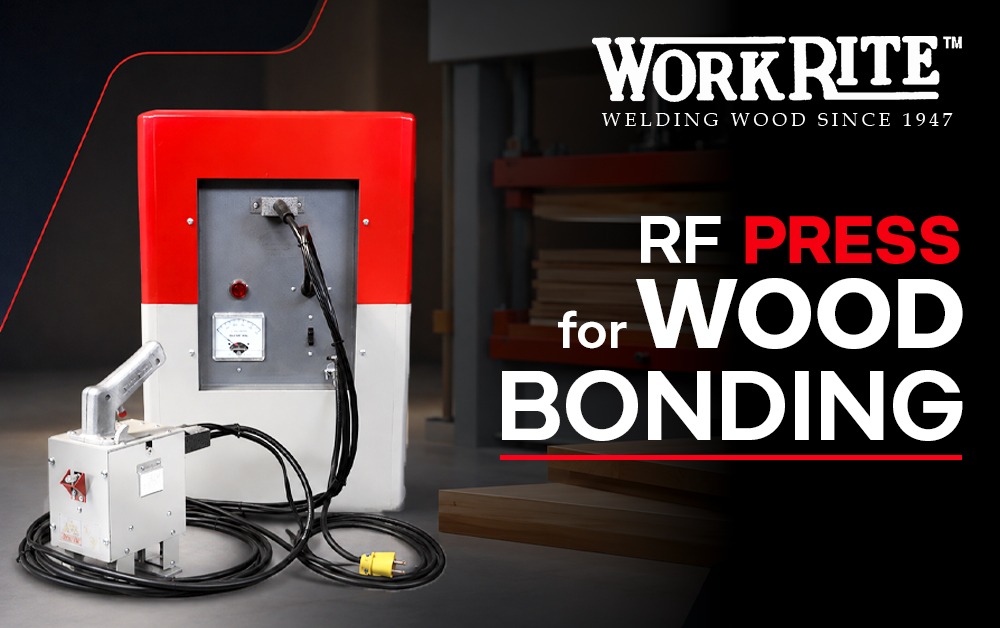
RF press for wood bonding technology provides woodworking manufacturers with a faster and more controlled method for curing adhesive joints. Instead of relying only on conventional air drying, clamping, or external heating, an RF press uses radio frequency energy to generate heat within the adhesive line. This allows glued wood components to develop strong bonds in a significantly shorter processing time while maintaining consistent pressure and curing conditions.
For manufacturers working with high production volumes, improving the speed and consistency of adhesive curing can have a direct impact on productivity. A properly designed RF press for wood bonding can reduce waiting time between assembly and handling, improve production flow, and help manufacturers achieve more uniform results across repeated workpieces. Workrite Wood Welder provides RF wood welding technology designed to support efficient and reliable woodworking operations.
What Is an RF Press for Wood Bonding?
An RF press for wood bonding is an industrial machine that combines pressure with radio frequency energy to accelerate the curing of suitable wood adhesives. The wood components are positioned together with adhesive between the surfaces, after which pressure is applied to hold the joint securely in place. RF energy is then introduced into the assembly.
The radio frequency field causes molecules within the adhesive and surrounding material to respond rapidly, generating heat internally rather than depending entirely on heat traveling from an outside surface. Because the adhesive can be heated more directly, curing can occur much faster than with many conventional bonding methods. Once the required curing cycle is completed, the pressure can be released and the bonded component can move to the next production stage.
How RF Wood Bonding Technology Works
The effectiveness of an RF press for wood bonding comes from the combination of adhesive, pressure, and high-frequency energy. First, an appropriate adhesive is applied to the surfaces that need to be joined. The components are then accurately positioned inside the press so that the joint receives consistent pressure.
After the assembly is positioned, the RF system generates a high-frequency electromagnetic field. Industrial RF systems commonly operate at an allocated frequency such as 27.12 MHz. The energy interacts with the adhesive system, producing internal heating that helps accelerate the curing process.
Pressure remains important throughout the cycle because it keeps the wood components correctly aligned while the adhesive develops its bond. After the programmed RF cycle is complete, the assembly can be allowed to stabilize before being removed from the press. Machine settings, adhesive selection, wood species, moisture content, joint design, and component dimensions all influence the ideal processing conditions.
Why Use an RF Press for Wood Bonding?
One of the biggest advantages of an RF press for wood bonding is production speed. Traditional adhesive curing can require substantial waiting time, particularly when manufacturers need large quantities of assembled components. RF technology can shorten curing cycles, allowing production teams to move bonded parts through manufacturing more quickly.
Another important benefit is consistency. RF energy can provide controlled internal heating within the bonding area, helping manufacturers achieve more repeatable adhesive curing when the process is correctly configured. Consistent curing can contribute to stronger and more reliable joints while reducing variations between production cycles.
RF pressing can also improve the utilization of factory space. When bonded components require long periods of conventional clamping or drying, work-in-process materials can occupy valuable floor space. Faster curing can help reduce this accumulation and create a more organized production flow.
Improved Production Efficiency
Manufacturers are constantly looking for ways to increase output without compromising product quality. An RF press for wood bonding can become an important part of this strategy by reducing the time required for adhesive curing.
Shorter curing cycles can allow operators to process more components within a given production period. The technology can also reduce the dependency on lengthy holding periods, making it easier to coordinate bonding with subsequent machining, finishing, and assembly operations.
For businesses producing repeated wood components, the ability to establish controlled and repeatable RF cycles can make production planning easier. Rather than allowing glued assemblies to remain clamped for extended periods, manufacturers can integrate RF curing into a more streamlined workflow.
Consistent Pressure and Strong Adhesive Joints
Pressure is a critical part of successful wood bonding. When two wood surfaces are joined, consistent pressure helps maintain contact while the adhesive cures. Uneven pressure can contribute to inconsistent joints, gaps, or variations in finished components.
An RF press combines controlled pressing with accelerated adhesive curing. When the adhesive, pressure, RF power, and cycle time are correctly matched to the application, manufacturers can achieve repeatable bonding results. This is particularly valuable for production environments where many components must meet the same dimensional and quality requirements.
The goal is not simply to cure adhesive faster. A properly configured RF process should provide a controlled bonding environment that supports both production efficiency and finished-product quality.
RF Press vs. Conventional Wood Bonding Methods
Conventional wood bonding commonly depends on mechanical clamping followed by natural or ambient adhesive curing. While this approach can work effectively for many applications, curing time may become a production limitation when large numbers of components must be processed.
An RF press for wood bonding introduces a different approach by using electromagnetic energy to accelerate heating within the adhesive system. This can significantly reduce curing time compared with processes that depend primarily on heat transfer from the surrounding environment.
RF technology can therefore be particularly valuable where production volume, repeatability, and cycle time are important considerations. However, the correct adhesive and process parameters are essential because not every adhesive or wood assembly is automatically suitable for RF curing.
RF Press for Wood Bonding Applications Across Wood Manufacturing
RF wood bonding technology can be used in a range of manufacturing environments where adhesive joints require rapid and controlled curing. Depending on the machine configuration and adhesive system, RF pressing can support the production of furniture components, wood frames, curved or formed assemblies, laminated components, and other engineered wood products.
The technology is especially useful when manufacturers need to maintain dimensional accuracy while reducing curing time. By holding components under pressure during the RF cycle, manufacturers can help maintain the intended geometry of the assembly while the adhesive develops its bond.
For companies producing large quantities of similar components, RF technology can also support process standardization. Operators can establish repeatable machine settings and production procedures, helping reduce unnecessary variation between individual bonding cycles.
Choosing the Right RF Press
Selecting the right RF press for wood bonding requires more than simply comparing machine size or power. Manufacturers should consider the dimensions of the components being bonded, production volume, adhesive characteristics, required pressing force, operating frequency, available workspace, and the desired production cycle.
Machine configuration is another important consideration. Different woodworking operations may require different press designs, electrode arrangements, pressure systems, and control features. A machine should be selected according to the actual bonding requirements rather than based solely on general specifications.
Working with an experienced RF Press for Wood Bonding equipment manufacturer can help manufacturers determine which configuration is appropriate for their production needs. Proper machine selection can improve efficiency while avoiding unnecessary equipment limitations as production requirements grow.
Workrite Wood Welder for Efficient Wood Bonding
Workrite Wood Welder focuses on RF wood welding and bonding equipment designed for demanding woodworking environments. An RF press can provide manufacturers with a practical way to accelerate adhesive curing while maintaining controlled pressure and repeatable processing conditions.
For businesses looking to improve production speed, reduce adhesive curing delays, and create a more efficient manufacturing workflow, RF wood bonding technology can offer a valuable alternative to conventional curing methods. The right equipment, adhesive, tooling, and process settings work together to deliver reliable results.
If your manufacturing operation requires faster adhesive curing and consistent wood assembly, explore the RF wood welding solutions available from Workrite Wood Welder and determine how an RF press can fit into your production process.
Conclusion
An RF press for wood bonding combines pressure and radio frequency energy to accelerate adhesive curing and improve production efficiency. By generating heat within the bonding area, RF technology can reduce curing times while supporting consistent adhesive performance and accurate component positioning.
For woodworking manufacturers, this technology can help streamline production, reduce waiting periods, improve workflow, and support repeatable bonding results. As production demands increase, investing in suitable RF wood bonding equipment can provide manufacturers with a practical way to improve both productivity and process control.
Frequently Asked Questions
1. What is an RF press for wood bonding?
An RF press for wood bonding uses radio frequency energy to accelerate the curing of adhesive between wood components. The RF field generates heat within the bonding area while pressure holds the materials securely together. This process can significantly reduce clamping time and help manufacturers achieve consistent, efficient wood bonding during production.
2. How does an RF press improve wood bonding?
An RF press improves wood bonding by combining controlled pressure with high-frequency energy to accelerate adhesive curing. Instead of waiting for glue to cure naturally over an extended period, RF technology helps set suitable adhesives much faster. This can improve production speed, reduce handling delays, and create a more streamlined manufacturing process.
3. What frequency does a WorkRite RF wood welder use?
WorkRite wood welders operate at a 27.12 MHz radio frequency, which is used to generate heat within the glue line for faster adhesive setting. The company’s newer Model 5000 is designed around this frequency and can penetrate approximately two inches of wood for glue setting, depending on application conditions.
4. What are the benefits of using an RF press for wood bonding?
An RF press for wood bonding can greatly reduce adhesive setting and clamping time, helping manufacturers increase production efficiency. RF technology also supports consistent glue curing and can eliminate the need for visible nails or staples in suitable applications. WorkRite states that its wood welders can set glue in seconds and work with water-based wood glue.
5. Is an RF wood bonding machine suitable for industrial production?
Yes, RF wood bonding technology can be suitable for demanding production environments where faster adhesive curing and repeatable results are important. WorkRite’s equipment has been developed for woodworking and furniture manufacturing, with heavy-duty models designed for continuous factory use. Selecting the appropriate machine depends on the wood components, adhesive, production volume, and bonding requirements.

1 Comment